
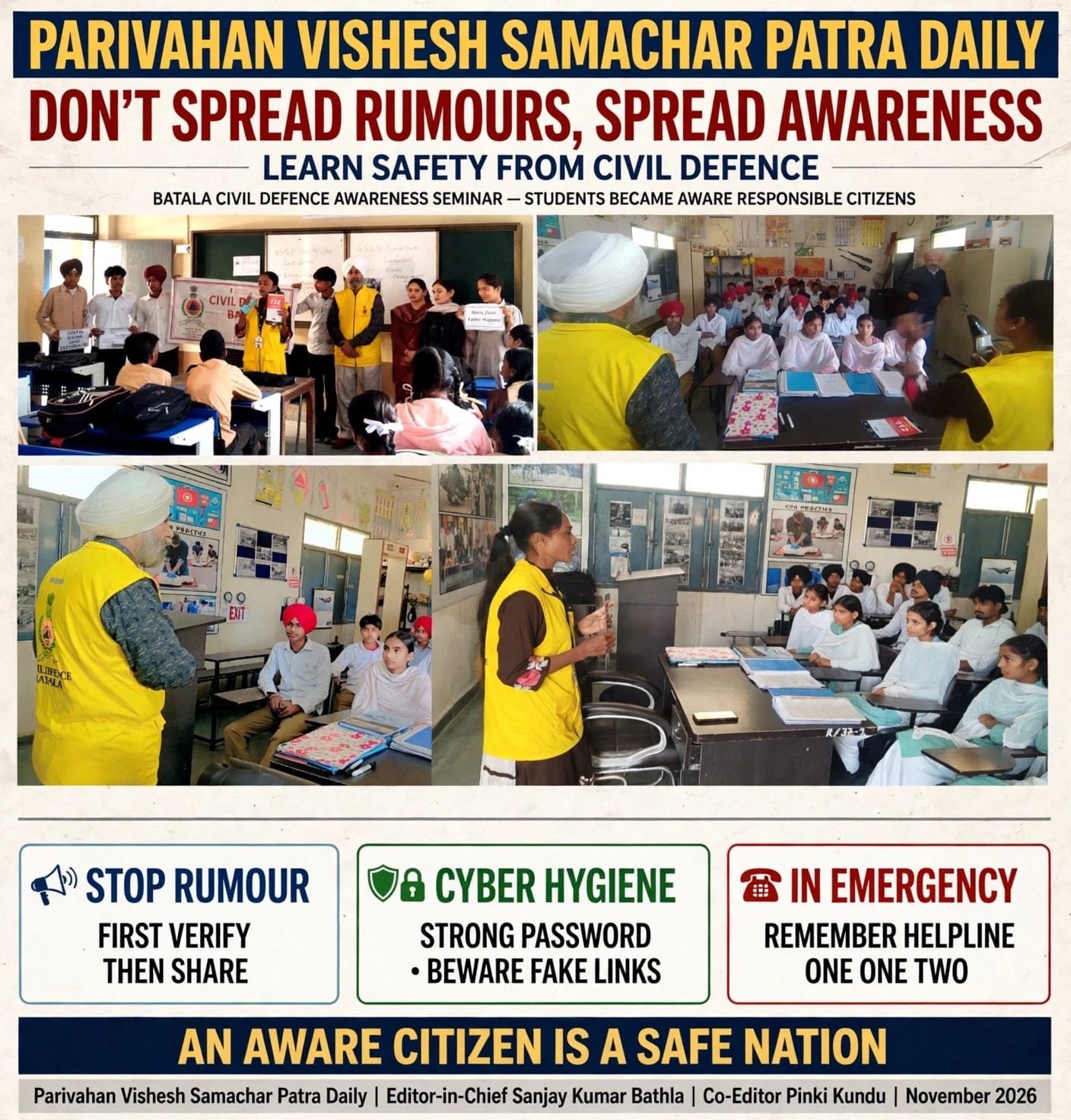
Don’t Spread Rumours, Spread Awareness
Learn Safety from Civil Defence
Civil Defence Awareness Seminar in Batala – Students became aware, responsible citizens
Stop rumours, follow cyber hygiene, take the right step in emergency – that is real safety
Special Report | Parivahan Vishesh Samachar Patra Daily
Note: This article is based on information shared in the seminar and details provided by the organisers.
Key Facts – At a Glance
- Where: Batala, Govt. Sen. Sec. School, Ghanie Ke Bangar and Singhpura
- When: 19 November
- Under whose directions: As per directions of Honourable Ravel Singh Randhawa, District Commander, Punjab Home Guards-cum-Additional Controller, Civil Defence, Gurdaspur
- Organised by: Warden Service Post No. 8
- Under whose guidance: Under the guidance of Principal Surinder Singh and In-charge Anju Pawar
- Who participated: Vocational Trainers Paramjit Singh and Meenakshi, along with 200 NSQF students
- Special presence: Post Warden Harbakhash Singh and Maninder Kaur
- Topics: Civil Defence, prevention of rumours, cyber hygiene, emergency helpline, mental and physical health, duties of citizens and Artificial Intelligence (AI)
- What happened in the seminar?
A seminar on Civil Defence was organised by Warden Service Post No. 8 at Govt. Sen. Sec. School, Ghanie Ke Bangar and Singhpura in Batala.
The aim of the seminar was not just to deliver speeches, but to teach students that in a time of crisis, one should not panic, one should take the right step.
Under the guidance of Principal Surinder Singh and In-charge Anju Pawar, Vocational Trainers Paramjit Singh and Meenakshi turned the seminar into a dialogue by engaging the students. The special presence of Post Warden Harbakhash Singh and Maninder Kaur boosted the morale of the students.
An aware citizen is a safe nation.
- What is Civil Defence? – Not just a uniform, it is a responsibility
Students were told that Civil Defence does not mean only arrangements during war or disaster.
Civil Defence means –
- Be prepared in advance: Having information before an emergency
- Avoid rumours: Stopping fear and confusion from spreading
- Help others: Helping neighbours, classmates and elders in crisis
- Support administration: Following instructions of police, Home Guards, Civil Defence and health department
Students were explained that the security of the country does not begin only at the border, it also begins from school, neighbourhood, home and mobile phone.
- Rumour – The most dangerous weapon
The most important message of the seminar was – prevention of rumours.
It was explained that in today’s world, hostile nations and hackers often attempt to target a country’s critical infrastructure and ordinary citizens through cyberattacks, espionage and fake news rather than direct military attacks.
Attempts are made to create fear and mistrust in society by spreading anti-national content and false rumours through social media.
Three rules were taught to students –
- First verify, then share: If you get sensational news, do not forward it immediately
- Check a reliable source: Confirm from government information, reputed newspaper, school-administration
- Do not spread fear: If the news looks doubtful, stop it there, the rumour ends there
One forward spreads a rumour, one stop saves society.
- Cyber Hygiene – Safety in the digital world
Detailed information was provided in the seminar about the importance of Cyber Hygiene and the daily precautions required to protect networks and personal data.
Students were told –
- Keep a strong password: Do not keep an easy password like name or date of birth
- Beware of fake links: Do not click on links offering prize, job or lottery
- Do not share OTP with anyone: If someone asks for OTP posing as bank, police or relative, refuse
- Maintain privacy: Do not share your photo, location, school time-table with strangers
- Do not remain silent on cyberbullying: If someone troubles you, tell your parents and teachers
Cybersecurity was described as our first line of defence.
- What to do in an emergency? – Remember Helpline 112
Important information was also shared in the seminar regarding mental and physical health, the responsibilities of citizens, emergency helpline number 112, and Artificial Intelligence (AI).
In an emergency –
- Do not panic, call for help: Call 112
- Give correct information: Clearly tell place, incident, how many people are affected
- Keep yourself safe: Do not risk your life by jumping into fire, current, crowd or water
- Give way to others: Give way to ambulance, police and fire brigade
Message on AI –
- AI is a tool for learning, not for creating rumours
- Do not believe and share fake photos-videos made by AI as truth
- Use technology responsibly
- What did the students learn?
At the conclusion of the seminar, students were encouraged to become aware, responsible and safety-conscious citizens.
They were asked to actively contribute towards the security and well-being of the nation and society.
A student’s pledge should be –
- I will not spread rumours
- I will follow cyber safety
- I will call the right help in emergency
- I will help others
- Editorial Conclusion – Safety of the nation begins from school
This seminar in Batala may look small, but its message is big.
When 200 students learn to stop rumours, maintain cyber safety and take the right step in emergency, they carry this awareness to 200 homes.
This is Civil Defence – Every citizen a soldier, every student a sentinel.
Rumour spreads fear, awareness spreads safety.
Batala has shown – safety begins from school.